



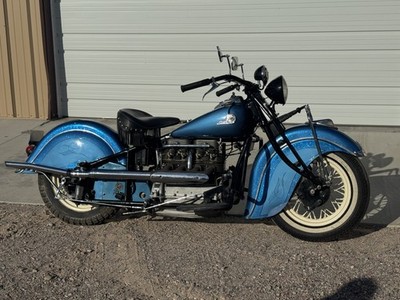


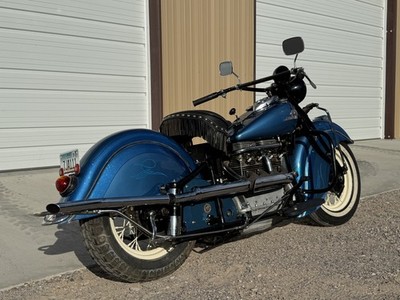







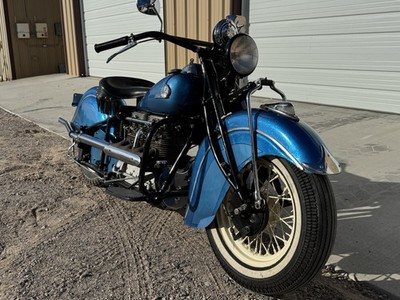






When do you ever see a Indian four cylinder come up for sale? That's right hardly ever!! and get this, this one runs and rides!!
Year: 1942 Make: Indian
Model: 442 Four Cylinder
Color: Metallic Blue with Pin Stripes
Engine Size: 1200cc - 74"cu
Cylinders: 4 Transmission: 3 Speed
Mileage: 000100
VIN Number: DDB400
Belly Numbers: N/A
Frame Number: 442400
Motorcycle Currently Registered: Yes
Ownership: Clear Title in Owners Name
Motorcycle Location: Phoenix, AZ area
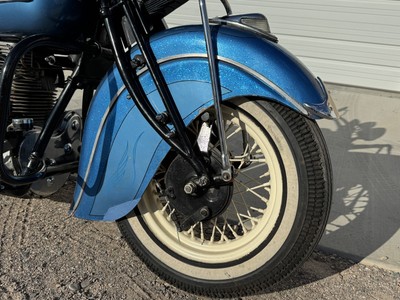
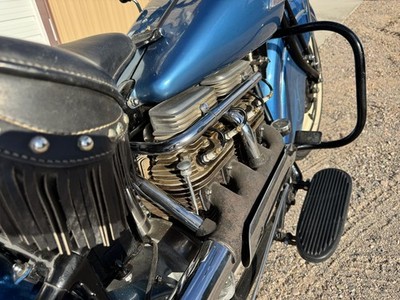
Sheet Metal: Fender and Tanks are original and in excellent condition.
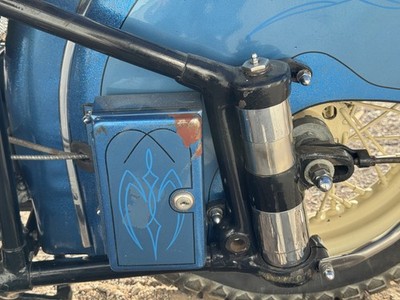
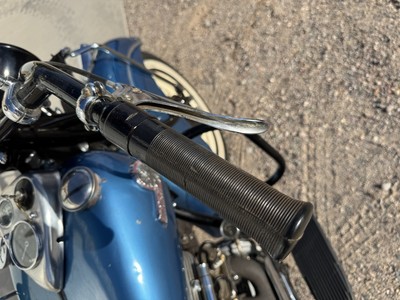
Paint Condition: I am guessing by the paint that this motorcycle was probably done sometime back in the 70's? Features heavy Metallic Paint Flake and old school pinstriping. There is some Paint Flakes, Chips, and Scrapes. No Major rust or pitting.
Wheel and Tire Condition: Tires hold air, if you want to make a daily rider, it is suggested to replace.
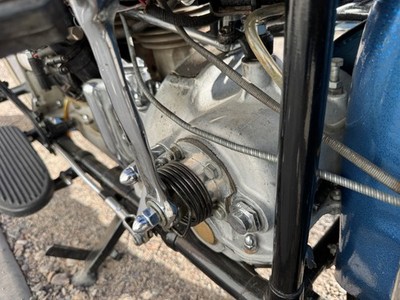
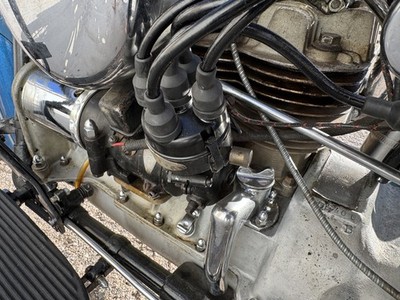
Mechanical Condition: This four cylinder starts easy, a couple prime kicks, barely touch it on the ignition kick and it purrs to life, this thing runs and rides down the road very good,
Additional Information:
Historical background
The Indian Four was built from 1928–1942 by the Indian Motocycle Company in Springfield, Massachusetts. Its engine design came from the Ace inline-four: Indian bought Ace Motor Corporation in 1927 and put the Ace Four engine into an Indian frame, initially badged “Indian Ace” before it simply became the Indian Four.
The Four was Indian’s prestige, high-dollar luxury model – period advertising and later valuations note that it cost about as much as a new Pontiac car when new.
Early Fours used a rigid rear frame; in 1940 Indian updated the chassis with plunger rear suspension and the now-iconic deep skirted fenders that carried through to the end of production.
Civilian production, including the Four, ended in 1942 as Indian shifted to military contracts; the Four never returned after WWII, making 1942 the final and rarest year.
1940–42 styling & chassis details
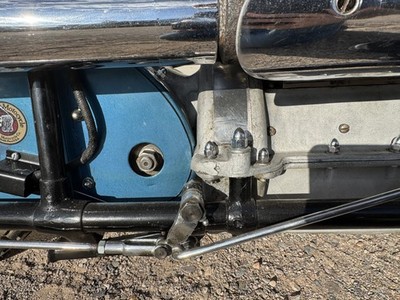
Frame & suspension Steel double-cradle frame.
Front: trailing-link fork with a quarter-elliptic leaf spring.
Rear: plunger rear suspension introduced in 1940, still used in 1942.
Wheels 18" wheels on earlier models; by 1941–42 Indian used 16" wheels with balloon tires, which give the late Fours their “fat” stance.
Fenders & sheet metal Large, fully skirted valanced fenders front and rear, with Indian’s beak-style front light on many bikes.
Teardrop fuel tanks with multicolor Indian badges and pinstriping were standard; colors varied, including classic Indian red and darker blues/greens depending on order and restoration choices.
Engine & drivetrain (late-style Four)
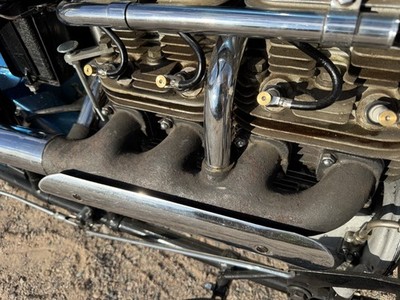
For a 1941–42 Four, specs are essentially the same as other late Fours: Type: Air-cooled, longitudinal inline four-cylinder, four-stroke.
Configuration: Classic F-head / IOE (inlet-over-exhaust) – overhead intake valves with side exhaust valves. Displacement: Commonly quoted as 77 cu in (≈1,265 cc); some literature rounds to 78 cu in, and at least one reference to a 1942 442 lists it as 74"—so you’ll see slightly different numbers depending on the source, but it’s the same basic big inline-four. Bore x stroke: about 2.75" à 3.25" (70 mm à 83 mm).
Carburetor: Linkert, typically M441 on late Fours.
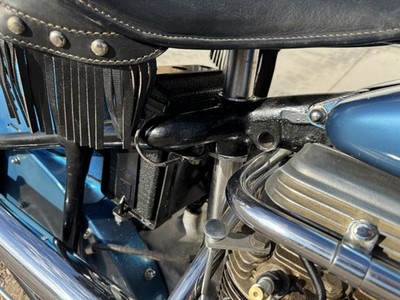
Ignition: Battery ignition on many 442s (Auto-Lite system); some 1942 four-cylinder Indians were also offered in magneto form.
Power output: Period figures and later summaries put it in the 30–40 hp range, enough for genuine highway speeds in its day.
Transmission: 3- or 4-speed hand-shift gearbox driving the rear wheel via chain (many 1942 442s are described with 3-speed boxes).
Exhaust: Distinctive four-into-one manifold running to a single muffler on the right side.
Dimensions & running gear (typical late Four) (These figures are for the late-production Four in general; exact numbers can vary slightly by source.)
Dry weight: roughly 550–570 lb – heavier than the early rigid-frame Fours, which were closer to 450 lb.
Fuel capacity: about 4.6 gallons (17.4 L).
Brakes: Drum front and rear.
Top speed: contemporary and later road tests suggest up to 90–100 mph for a well-tuned machine, which made it one of the fastest American road bikes of its day.
1942-only / late-production notes Last year of the Four: 1942 was the final year; after war production, Indian never brought a four-cylinder back.
Production numbers: Multiple auction descriptions and references note fewer than ~300 Four-cylinder bikes built in 1942, making them extremely scarce.
Model designations: You’ll commonly see Model 441 or 442 used for 1942 Fours in valuation guides and sales listings. Because 1942 was a short civilian model year before full wartime conversion, many surviving examples show very low original mileage and long periods of storage, making originality a big deal in the collector market.
Year: 1942 Make: Indian
Model: 442 Four Cylinder
Color: Metallic Blue with Pin Stripes
Engine Size: 1200cc - 74"cu
Cylinders: 4 Transmission: 3 Speed
Mileage: 000100
VIN Number: DDB400
Belly Numbers: N/A
Frame Number: 442400
Motorcycle Currently Registered: Yes
Ownership: Clear Title in Owners Name
Motorcycle Location: Phoenix, AZ area
Sheet Metal: Fender and Tanks are original and in excellent condition.
Paint Condition: I am guessing by the paint that this motorcycle was probably done sometime back in the 70's? Features heavy Metallic Paint Flake and old school pinstriping. There is some Paint Flakes, Chips, and Scrapes. No Major rust or pitting.
Wheel and Tire Condition: Tires hold air, if you want to make a daily rider, it is suggested to replace.
Mechanical Condition: This four cylinder starts easy, a couple prime kicks, barely touch it on the ignition kick and it purrs to life, this thing runs and rides down the road very good,
Additional Information:
Historical background
The Indian Four was built from 1928–1942 by the Indian Motocycle Company in Springfield, Massachusetts. Its engine design came from the Ace inline-four: Indian bought Ace Motor Corporation in 1927 and put the Ace Four engine into an Indian frame, initially badged “Indian Ace” before it simply became the Indian Four.
The Four was Indian’s prestige, high-dollar luxury model – period advertising and later valuations note that it cost about as much as a new Pontiac car when new.
Early Fours used a rigid rear frame; in 1940 Indian updated the chassis with plunger rear suspension and the now-iconic deep skirted fenders that carried through to the end of production.
Civilian production, including the Four, ended in 1942 as Indian shifted to military contracts; the Four never returned after WWII, making 1942 the final and rarest year.
1940–42 styling & chassis details
Frame & suspension Steel double-cradle frame.
Front: trailing-link fork with a quarter-elliptic leaf spring.
Rear: plunger rear suspension introduced in 1940, still used in 1942.
Wheels 18" wheels on earlier models; by 1941–42 Indian used 16" wheels with balloon tires, which give the late Fours their “fat” stance.
Fenders & sheet metal Large, fully skirted valanced fenders front and rear, with Indian’s beak-style front light on many bikes.
Teardrop fuel tanks with multicolor Indian badges and pinstriping were standard; colors varied, including classic Indian red and darker blues/greens depending on order and restoration choices.
Engine & drivetrain (late-style Four)
For a 1941–42 Four, specs are essentially the same as other late Fours: Type: Air-cooled, longitudinal inline four-cylinder, four-stroke.
Configuration: Classic F-head / IOE (inlet-over-exhaust) – overhead intake valves with side exhaust valves. Displacement: Commonly quoted as 77 cu in (≈1,265 cc); some literature rounds to 78 cu in, and at least one reference to a 1942 442 lists it as 74"—so you’ll see slightly different numbers depending on the source, but it’s the same basic big inline-four. Bore x stroke: about 2.75" à 3.25" (70 mm à 83 mm).
Carburetor: Linkert, typically M441 on late Fours.
Ignition: Battery ignition on many 442s (Auto-Lite system); some 1942 four-cylinder Indians were also offered in magneto form.
Power output: Period figures and later summaries put it in the 30–40 hp range, enough for genuine highway speeds in its day.
Transmission: 3- or 4-speed hand-shift gearbox driving the rear wheel via chain (many 1942 442s are described with 3-speed boxes).
Exhaust: Distinctive four-into-one manifold running to a single muffler on the right side.
Dimensions & running gear (typical late Four) (These figures are for the late-production Four in general; exact numbers can vary slightly by source.)
Dry weight: roughly 550–570 lb – heavier than the early rigid-frame Fours, which were closer to 450 lb.
Fuel capacity: about 4.6 gallons (17.4 L).
Brakes: Drum front and rear.
Top speed: contemporary and later road tests suggest up to 90–100 mph for a well-tuned machine, which made it one of the fastest American road bikes of its day.
1942-only / late-production notes Last year of the Four: 1942 was the final year; after war production, Indian never brought a four-cylinder back.
Production numbers: Multiple auction descriptions and references note fewer than ~300 Four-cylinder bikes built in 1942, making them extremely scarce.
Model designations: You’ll commonly see Model 441 or 442 used for 1942 Fours in valuation guides and sales listings. Because 1942 was a short civilian model year before full wartime conversion, many surviving examples show very low original mileage and long periods of storage, making originality a big deal in the collector market.


